FAQ – Frequently Asked Questions
General
The energy storage system is controlled by a smart meter, and SAX Power offers suitable devices. The smart meter is installed by an electrician behind the electricity meter in the control cabinet and measures both the energy leaving the house (fed into the grid) and the energy purchased by you (drawn from the grid). The smart meter controls the storage system in such a way that the amount of purchased and fed-in energy is minimized. This allows you to store surplus electricity from the PV system and retrieve it later when PV production is insufficient.
The storage system can be monitored via a user-friendly dashboard in the web browser and a smartphone app. Here, you can view information such as the state of charge, and measurement data is displayed graphically. After delivery, you can create an account using the storage system’s serial number (Website: app.sax-power.net). For this purpose, the SAX storage systems are connected to the SAX Power company’s web server via a LAN interface. The values are also stored in a database (in Germany) and are thus available for maintenance purposes.
The SAX storage system provides extremely high safety: it can be shut down in 0.2 milliseconds, and then the entire storage system is below the safety voltage (40V), meaning it can be touched anywhere! This eliminates accidents caused by high voltage or overheating. You also benefit from extended service life: conventional battery storage systems with series connection are only as strong as their weakest cell, and production-related differences and even more so aging always result in losses—with the SAX circuit, the cell blocks are addressed individually so that each can be optimally utilized. Even if one cell were to fail completely, the rest of the battery remains usable. The system is also very robust, because the special circuit exposes the electronic components to only low voltage—this reduces the risk of defects.
Yes, there is a separate connection on the housing next to the normal power connection. If the mains voltage fails, the battery automatically detects this and switches to backup power mode. The devices connected to the backup power connection are therefore always supplied with power.
A backup power solution is also possible with the installation of a grid disconnect switch.
The storage system can be easily expanded to 2 or 3 units, even at any later time. Because we control each cell block individually and utilize it optimally, subsequently installed units are not affected by earlier storage units if their capacity has decreased due to natural aging processes. You can always use the full capacity of each unit.
Please ask your electrician or send us an inquiry by completing this form.
With our SAX Power Home Manager, the battery storage can also charge from the grid without a PV system and be used as an emergency power supply in the event of a power outage.
The performance values of our storage systems have been independently tested and scientifically confirmed.
The HTW Berlin Electricity Storage Inspection is one of the most important independent studies on the efficiency of PV home storage systems in the DACH region. No manufacturer pays for participation – the testing methodology is scientifically sound and publicly documented.
In the performance class up to 5 kW, the SAX Power Home Plus emerged as the leader in the 2026 Electricity Storage Inspection – with average efficiencies of over 97.6% and a standby consumption of only 4 watts. HTW also found that the usable energy content is even 8% higher than stated in the data sheet – meaning the storage system performs more than promised.
All results are publicly available: solar.htw-berlin.de
Your balancing meter from your electricity provider calculates this internally and balances to zero.
The balancing meter measures consumption and feed-in on all three phases and offsets them against each other.
Only in the case of backup power, i.e. during a power outage, should you ensure that a single-phase inverter is connected to the same phase as the SAX Home storage system, then
the SAX can simulate a grid for the inverter and the inverter will also start in backup power mode (grid disconnect switch required) and can supply the loads and the SAX storage system can also be charged.
(Inverter from 2018 onwards is required (due to frequency increase communication))
A photovoltaic system can also be operated without storage, allowing you to use the electricity only at the times it is generated.
However, a solar storage system offers several advantages:
- Independence: both in terms of energy supply and independence from rising electricity prices
Security during power outages (emergency power supply)
- Economic efficiency: the storage system is an investment that pays off as soon as the acquisition costs have been amortized
- Sustainability: You can use a larger portion of the electricity from your own roof, which is ecologically generated and does not require transportation.
- With the introduction of dynamic electricity tariffs, the storage system can, for example, charge inexpensive electricity from the grid at night, which can then be used during peak price periods.
Our SAX HEMS is required for this to be able to query current prices.
Technical
No, the power fed into the grid does not pass through the storage system. The priority is: 1. Self-consumption, 2. SAX storage system, 3. Grid feed-in.
Drawing energy without a grid connection is difficult, as the storage system draws the energy it needs to start from the grid. A so-called black start is installed in the storage system and can be activated manually to generate voltage and establish a grid so that the PV system inverter starts up again.
Yes, with our technology we only replace the battery-side inverter. The storage system is charged with AC power, so a PV-side inverter is required to provide the 230 V for the storage system.
In conventional installations with inverters, interference frequencies repeatedly occur in amateur radio or emergency service networks – operators are warned or must shut down their systems until the issue is resolved. Solar inverters have DC-side filters designed to prevent this; however, if a device is defective, disruptive harmonics can arise and be propagated by the AC wiring on the roof like an antenna. The clock frequency in SAX storage systems is 1000 times lower than in conventional IGBT inverters. Therefore, there are no EMC problems with SAX.
SAX Power uses lithium iron phosphate (LFP) cells—a premium product from the world’s leading manufacturer. These LFP cells have a high energy density and an efficiency of approx. 95% at 0.2 C. They also offer significantly greater protection against fire and explosion than, for example, NMC cells (nickel manganese cobalt).
The storage system can supply all devices, single-phase or three-phase. As long as energy is stored in the battery, it is used for all consumers connected in the house and no electricity is drawn from the grid. Even in the event of a grid failure, the emergency power function (UPS) can supply all or individual consumers from the battery. – Technical: These three-phase consumers are supplied by the grid and by the storage system. The electricity meter always measures the sum of the three phases together. The sum of the three-phase power is measured by the SAX battery’s smart meter and used for control. This power is regulated to zero as much as possible, the so-called “zero storage”. This means that even though the storage system is single-phase, it can fully supply both single-phase and three-phase devices.
In backup power mode, 3 SAX storage systems also generate three-phase current, allowing three-phase consumers to continue operating.
We use high-quality LiFePO4 cells (lithium iron phosphate) from the third-largest battery manufacturer. The cells are very safe, as they only ignite at 400°C. By comparison, NMC cells (nickel manganese cobalt), which some manufacturers use, can ignite at around 120°C. Our cells are free of environmentally harmful cobalt and, at 180 Wh/kg, have a high energy density.
SAX Power is currently the only manufacturer in the world to have found a way to make this technology economically viable for smaller systems such as solar storage units. Here is a link to an explanation of the technical background:
https://www.finepower.com/fachartikel-hocheffizienter-umrichter-fuer-batteriespeichersysteme/
This figure refers to the conversion from direct current to alternating current, which is performed by the electronics of the battery management system. For comparison: conventional IGBT inverters achieve up to 96%. The SAX process, which is software-based and therefore does not require an additional device, not only reduces space requirements and costs, but also increases efficiency—less energy is lost during conversion. The 98.6% has been confirmed by independent measurements. The operating point to which the efficiency refers is a power output of 2,500 W. Regarding the efficiency of the battery cells: The SAX storage system uses high-quality LFP cells (lithium iron phosphate), which have an efficiency of approximately 95% at 0.2 C.
In the SAX battery, the cell blocks are not simply connected in series as in conventional batteries; instead, they can be individually addressed via a special circuit (cascaded H-bridges). This allows the electronics to work with many individual DC voltage values and combine them in various ways. By assembling these into a sine wave, AC current is generated. This method is significantly more efficient than current inverter technology (IGBT) – only the SAX principle achieves a conversion efficiency of 98.6%.
To achieve high voltages in conventional battery storage systems, the cells are connected in series. Because their capacity, self-discharge rate and temperature characteristics differ slightly—further amplified by ageing—during charging some cells have not yet reached their maximum level while others are already fully charged: charging must be stopped. Accordingly, during discharging operation is stopped even though some cells still have energy stored. To compensate for this, the widely used passive balancing converts part of the electrical energy from already charged cells into heat, which makes further charging possible. This wastes energy, and the method also offers no solution for discharging. The usable capacity of a battery storage system is therefore determined by the weakest cell and can be reduced by more than 50%. Active balancing avoids this, but requires complex circuitry with power-electronic components and sophisticated control. SAX Power has solved these problems using so-called cascaded H-bridges—this allows blocks of battery cells to be switched on individually or bypassed, enabling fast cell balancing. If individual cells fail, the remaining storage system can continue to operate—availability is therefore much higher than with conventional circuitry, and the battery’s service life is significantly longer.
The charging power of the SAX Power Home Plus 7.7kWh is a maximum of 3,500 watts and the discharge power is a maximum of 4.6kW, as the lines are protected with 20A. The power of the SAX Power Home 5.8kWh is a maximum of 2,500 watts and the discharge power is a maximum of 4.6kW. In Austria and Switzerland, as well as partially in other EU countries, the discharge power is limited to 3.7kW, as the line behind the circuit breaker, where the storage system is then connected, is only designed for 16 amperes (230V * 16A = 3.7kW).
The efficiency of the conversion (from DC to AC) is very high with SAX technology, achieving an efficiency of 98.6% (conventional IGBT inverters reach approximately 92 to 96%). All storage systems also experience losses in the battery cells – these are beyond our control and depend on the charging power and temperature.
Read more here: HTW Berlin Energy Storage Inspection
Battery cells can be damaged if they are charged too low or too high. However, the storage system monitors this automatically and never discharges the cells completely. Even when the storage system displays 0%, it is technically not yet completely empty, and similarly not completely full at 100%: a buffer always remains at the top and bottom to ensure the cells remain in perfect condition.
We guarantee a residual capacity of 80% after 10 years of use. Typically, 300 cycles per year are calculated, which equals 3,000 cycles in 10 years. However, these are full cycles, and we do not operate across the entire voltage range of the cell. The lifespan of the SAX storage system is also extended compared to conventional systems through rotating charge balancing.
The battery cells are not simply connected in series as in conventional systems; instead, they are connected by the control system via so-called cascaded H-bridges. This means we group the battery cells and address these groups individually—allowing us to utilize them optimally and also work flexibly with the groups’ voltage levels. This requires a very complex control and regulation network; we are currently the only provider on the market to offer this.
Within the SAX Power battery, the electronics of the Battery Management System (BMS) handle the conversion from direct current (DC) to alternating current (AC). Therefore, there is no separate inverter device, nor is one concealed within the battery housing. Instead, this function is integrated into the existing Battery Management System (BMS). Thus, the inverter functionality is software-driven and no longer requires dedicated hardware.
Installation
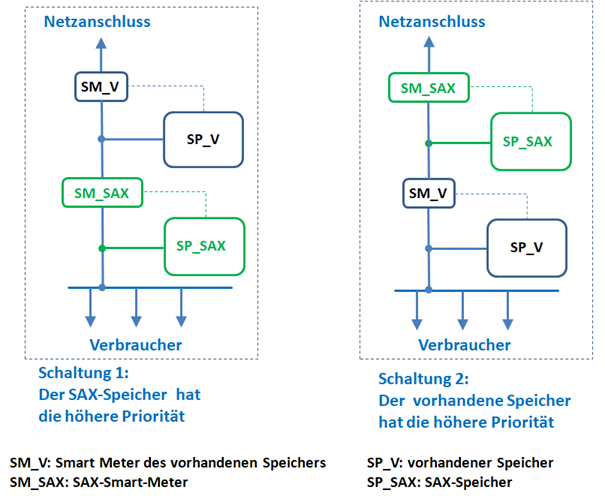
SAX storage systems are ideal for expanding existing solar systems with storage units from various manufacturers. The expansion can be implemented easily, with two circuit variants available for parallel operation of the SAX storage systems with the existing storage units.
In circuit 1, the SAX storage system has higher priority, meaning it is fully charged or discharged first. If its output or capacity is not sufficient for the grid, the existing storage unit is used.
In circuit 2, it is exactly the opposite: the existing storage unit has higher priority and is charged and discharged first before the SAX storage system is used.
The wallbox should be programmed as the master, as the storage unit does not assume the function of the control unit in a smart home. SAX Power recommends autonomous control of the storage unit via the smart meter, which is the safest option. The wallbox can then additionally control the storage unit (provide limits for charge/discharge power, read out state of charge and power). For communication with the wallbox, the storage unit supports Modbus RTU, Modbus TCP/IP, and Modbus UDP protocols, which are described in the user manual. Our SAX Power Home Manager can also be used, or you can inquire about compatibility with an existing EMS or HEMS system.
The storage unit can be wall-mounted if the wall is load-bearing. Alternatively, we offer a stand that can accommodate up to 3 storage units. The dimensions of the stand are 35 cm x 70 cm x 180 cm.
No, the SAX home storage system is not suitable for outdoor use. It is IP30-certified and should be operated at temperatures from +5 to a maximum of +35 °C.
No, the installation must be carried out by a trained electrician, as this is legally required in Germany. An electrician registered with the grid operators must register the storage system with the grid operator after commissioning.
The standard installation includes a smart meter (type ADL400 or ADW200), which is installed in the fuse box behind the electricity meter. The storage unit is connected to the smart meter via cable (RS485 interface, 2 wires of a communication cable such as LiYcY 2x 0.5 mm²). The storage unit is connected to one phase via a power cable. In addition, the storage unit is connected to the internet via a LAN cable.
No, the storage system is AC-coupled, so a PV inverter is still required. The storage system is charged with alternating current and outputs alternating current.
Not necessarily, as several connection options are available for the storage system. The power connection can be made via a dedicated cable or via a wall socket; communication between the storage system and the smart meter can be via cable or wireless. This results in three sensible installation options:
1) With the standard installation, a power cable and a communication cable to the smart meter run to the storage system—so it makes sense to install the storage system near the fuse box.
2) With the wireless installation, communication between the storage system and the smart meter is wireless, so no communication cable is required—only a power cable.
3) With the premium plug-in installation, the storage system is connected to any wall socket in the house (this simply needs to be replaced with a fused socket) and communication is wireless. In this variant, the installation location is independent of the fuse box location; the storage system can, for example, be installed in a living area. This is also not an issue in terms of noise, because the high efficiency generates hardly any heat and no cooling is required. Our storage systems use purely passive cooling and have no fans or blowers that could generate noise.
Yes, an internet connection is necessary for the storage system to be connected to the web server. The storage system has a LAN port. If a LAN cable cannot be run to the router/switch, Powerline (internet via power outlet) or a repeater (receives the home Wi-Fi and has a LAN port) can be used.
An internet connection is required for warranty and guarantee purposes.
For Electricians
Installing the storage system is very straightforward: mount the unit, install the smart meter in the control cabinet, run the cabling to the storage system, connect the storage system, switch it on—done.
Parameterization is already carried out at the factory by SAX Power; if required, the electrician can still change it at the customer’s site using SAX Power software. No parameter settings or other programming are required on site during installation. Depending on the on-site conditions and the customer’s requirements, communication between the storage system and the smart meter can be via cable or LoRa wireless connection; the power connection of the storage system can be via cable or plug-in (Wieland socket). The LAN connection is possible via LAN cable, PowerLAN, receiver, etc. In addition to wall mounting, it is also possible to mount up to three units (a maximum of 2 for the 7.7 model) on the free-standing SAX stands.
This complies with the standard and is therefore safe. The fuse is rated at 16A, so it also works under continuous load.
SAX Power installation partners receive free training from us. The training does not take up much of your time, because installation with SAX is easier than with conventional systems. The existing PV installation does not need to be modified.
One storage unit is the master, the others are slaves. The RS485 cable is simply daisy-chained from the master to the 2nd and 3rd storage units.
4 mm² is sufficient (protects up to 25 A), as the storage system switches off at >20 A.